BUZZ: LOCWS: JACKIE CHETTUR | ART EXHIBITION | REVIEW


Jackie Chettur: …it is 89 days this morning since we left the Mumbles Head
Swansea Civic Centre
Until 23 May (open daily, 10am – 5pm)
***
LOCWS International works with artists to create new works that are conceived and exhibited in Swansea and respond to ‘the people, culture, heritage and landscape of the city. They have commissioned a new temporary artwork by Pontypridd-based Jackie Chettur for Spring 2010.
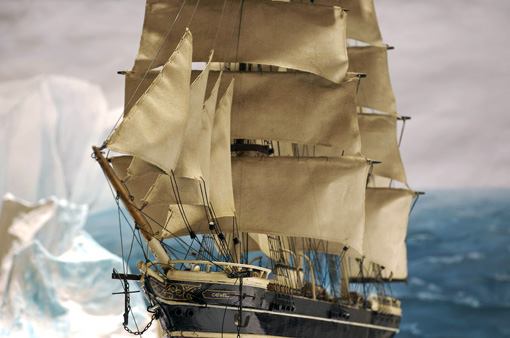
Chettur is an appropriate choice for LOCWS as she works predominantly with the landscape and personal stories, retelling shared histories with sensitivity and a pinch of romanticism. On an outcrop of grass between the Civic Centre – home of Swansea Council and Swansea Central Library – and the sandy beach of Swansea Bay the new artwork can be observed through eight turquoise viewers. Chettur’s site-specific dioramas were created through combining self-made background scenes and props with artefacts from Swansea museums, including ‘sailor made’ model ships, historic paintings, and journals. They feature three-mast ships approaching tropical islands with palm trees against sunsets or all-at-sea against dramatic skies.
On opening night the weather is appropriately grey and stormy, throwing wind and rain at the audience and adding atmosphere to the series of staged stereo photos Chettur has created using 3D imaging technology, inspired by the voyages of the Swansea Cape Horners. Mumble’s Head, past which the Cape Horners would have sailed, is visible in the distance beyond each viewer.
Above each image copper engravings feature quotes from a diary by Benjamin Davies, and industrial worker sent on one of Swansea’s copper barques. These provide further insight into the extraordinary sights during the ships’ long journeys to fetch copper ore from Chile in the late 1800s for the copper works in the lower Swansea valley. Thus an entry for ‘Wensday 3 day (Dec)’  reads ‘Clear sky but the sea looking verrey wild and rolling verrey heavy…thear came a large whale alongside the largest the captain had seen…at one O’clock pm thear came two…dolphins and went twice around the ship.’ Chettur’s image here is fantastical – the stuff of tall seafaring tales where creatures of the deep dwarf the Cape Horner and fire up the imagination.

Comments

Popular posts from this blog

Cardiff Writer's Circle: Annual Short Story Competition

It was a joy to return to Cardiff Writers' Circle to judge their annual Short Story Competition ...  Congratulations all! Here's their round up of the night: Throwback to Monday 23rd June, when we were thrilled to have 12 attendees join us for the Adjudication Event of our annual Short Story C ompetition - the winner and runners-up were announced, received their prizes, and graciously allowed pics to be taken for posterity! A huge round of applause goes to our winner, Gordon Harrop, who is fresh to CWC competitions. Gordon's winning entry served up some diabolical black humour, with a dark twist. Congratulations Gordon, and thank you for submitting such an entertaining and well-written piece! Gordon was joined on the podium by two of our long-standing members, Steve Pritchard and Angela Edwards Rigby, who are no strangers to receiving CWC awards and prizes. It was wonderful to hear their competition entries - Steve's story a page-turning "will-they-won't-they...

Gig Alert: Jemma L. King at Gwyl Lyfrau Abaraeron Book Festival 2025

There are l ots of great free events at Gwyl Lyfrau Abaraeron Book Festival 2025 this Sunday including Jemma L. King sharing poems from her new collection Moon Base One at 11.30am! Go along...

BOOK REVIEW: 'It deserves to be read far more widely.'

In her engaging review essay 'Fantastical Doubles and Split Selves' in the latest issue of New Welsh Review , author of The Word, JL George, looks at responses to trauma in three recent novels including Fox Bites by Lloyd Markham . Here are three of our favourite snippets: ‘Lloyd Markham’s first full-length novel Fox Bites , set in early-2000s Zimbabwe, takes a similar tack, colliding social upheaval – as viewed through the sometimes-uncomprehending eyes of a young, neurodivergent boy – with smaller, more personal disruptions. The young protagonist, Taban, suffers bullying and isolation among his peers after his family splits apart: his aunt, uncle, and beloved cousin Caleb moving away to a farm which will later be seized during land reforms.’ ‘Taban must resist the temptation to become part of a cycle of abuse, thereby becoming a conduit for the destruction of his world. Although the stakes of the book eventually become world-threatening in the expected way of science fiction...